

The Definitive Guide to AR Game Development: From Design Principles to Market Success
- January 5, 2026
- Posted by: Saravana N S
- Category: Game Development
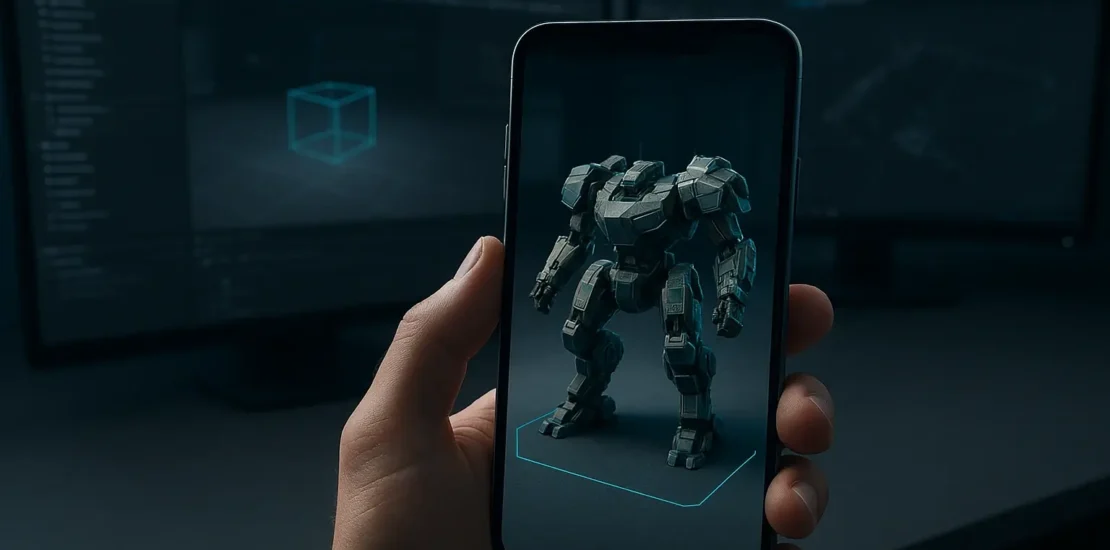
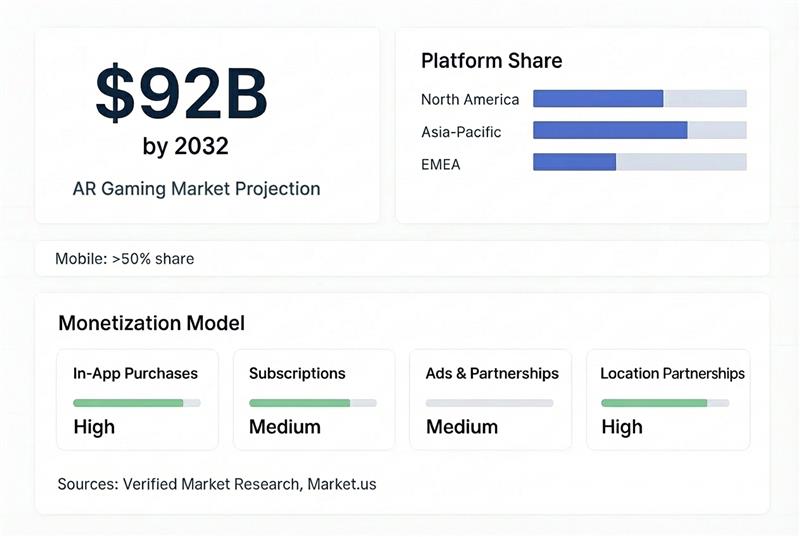
The augmented reality gaming market is on an explosive trajectory, projected to surge past $90 billion by 2032. For developers and publishers, this isn’t just an opportunity; it’s a new frontier of interactive entertainment. But navigating this frontier is complex. Moving from a great idea to a commercially successful AR game requires a deep understanding of new design paradigms, technical toolkits, and user expectations that are fundamentally different from traditional game development.
Many studios find themselves at a crossroads, evaluating how to blend the physical and digital worlds without creating experiences that feel gimmicky or frustrating. This guide is your strategic roadmap. We’ll move beyond the hype to provide the clear, actionable frameworks you need to make confident decisions—from choosing the right SDK to designing intuitive user experiences and building a sustainable monetization strategy.
Contents
- 1 The DNA of AR Game Design: Core Principles for Blending Worlds
- 2 Technical Foundations: Choosing Your AR Toolkit
- 3 A Practical UX Checklist for AR Game Readiness
- 4 Navigating the Minefield: Common AR Development Challenges & Solutions
- 5 Monetizing AR Games: Strategies for Sustainable Growth
- 6 The Road Ahead: Future-Proofing Your AR Game
- 7 Frequently Asked Questions
- 8 Your Partner in Building the Future of Play
The DNA of AR Game Design: Core Principles for Blending Worlds
Successful AR games feel like magic. They don’t just overlay digital content onto the real world; they make the real world part of the game. Achieving this requires a shift in thinking, moving away from screen-centric design to embrace spatial, context-aware principles.
Principle 1: Anchor the Experience in the User’s Reality
The most compelling AR experiences are tied directly to the player’s environment. Instead of forcing a pre-built world onto the user, design mechanics that react to and incorporate their physical space.
- Contextual Awareness: The game should understand surfaces, objects, and lighting. A character that realistically hides behind a real-life sofa is infinitely more immersive than one that floats in mid-air.
- Theme Consistency: The art style and narrative must complement the real world, not clash with it. A futuristic sci-fi game might work well in a modern office, while a fantasy game could feel more at home in a park or forest.
- Player Safety and Comfort: Always consider the player’s physical movement. Avoid mechanics that require sudden, rapid movements or force players to look in unsafe directions (e.g., into traffic). As research from Nielsen Norman Group highlights, clear signifiers and contextual instructions are crucial to prevent user frustration and ensure usability.
Principle 2: Design for Intuitive, Minimalist Interaction
In AR, the world is the interface. Overloading the user with complex UI elements or convoluted controls breaks immersion instantly.
- Minimize Friction: Interactions should be simple and direct. Think gestures, voice commands, or simple taps on virtual objects. The goal is to make the interaction feel as natural as interacting with a physical object.
- Guide, Don’t Command: Use subtle visual and audio cues to guide the player’s attention and actions. Animate a shimmer on an object to indicate it’s interactive rather than using a flashing “Click Here!” button.
- Manage Cognitive Load: The human brain is already processing the real world. Every digital element you add increases cognitive load. Display only the most essential information needed for the current task.
Unlike the often solitary nature of VR, AR shines in shared physical spaces. The future of AR gaming is social, transforming gameplay into a communal activity.
- Local Multiplayer: Design mechanics that allow multiple players in the same physical space to interact with the same virtual objects. Think collaborative puzzles or competitive tabletop-style games played on a real table.
- Persistent Worlds: Leverage spatial anchors to create virtual content that stays in place for all users to discover and interact with over time. This fosters a sense of shared discovery and community.
Principle 4: Integrate Accessibility from Day One
Accessibility in AR isn’t an afterthought; it’s a core design requirement. The diversity of physical environments and user abilities demands inclusive design.
- Multi-Modal Inputs: Support various interaction methods, including voice, gestures, and controllers, to accommodate different physical abilities.
- Environmental Adaptability: Your game must be playable in different lighting conditions, room sizes, and public vs. private spaces. Offer settings to adjust for low-light environments or smaller play areas.
- Clear Visual and Audio Cues: Ensure that all essential game information is conveyed through multiple channels to support players with visual or hearing impairments.
Technical Foundations: Choosing Your AR Toolkit
The right technology stack is the bedrock of your AR game. Your choice of Software Development Kit (SDK) will directly influence your game’s capabilities, performance, and platform reach. Each major SDK offers a different balance of features, making this one of the most critical early decisions in the augmented reality game development process.
- Apple ARKit: The go-to for iOS. It offers robust features like body tracking, scene geometry, and collaborative sessions, making it ideal for creating high-fidelity, socially interactive games for the Apple ecosystem.
- Google ARCore: The counterpart for Android. Its Geospatial API is a game-changer for location-based experiences, allowing you to anchor content to real-world locations with incredible precision.
- Unity AR Foundation / Unreal Engine: These game engines provide a cross-platform framework that sits on top of ARKit and ARCore. They are the preferred choice for most studios, enabling you to build once and deploy to both iOS and Android, which is critical for maximizing market reach.
- 8th Wall (Niantic): A leading platform for WebAR, which requires no app download. This is perfect for creating instantly accessible marketing activations, branded mini-games, or experiences where low friction is the top priority.
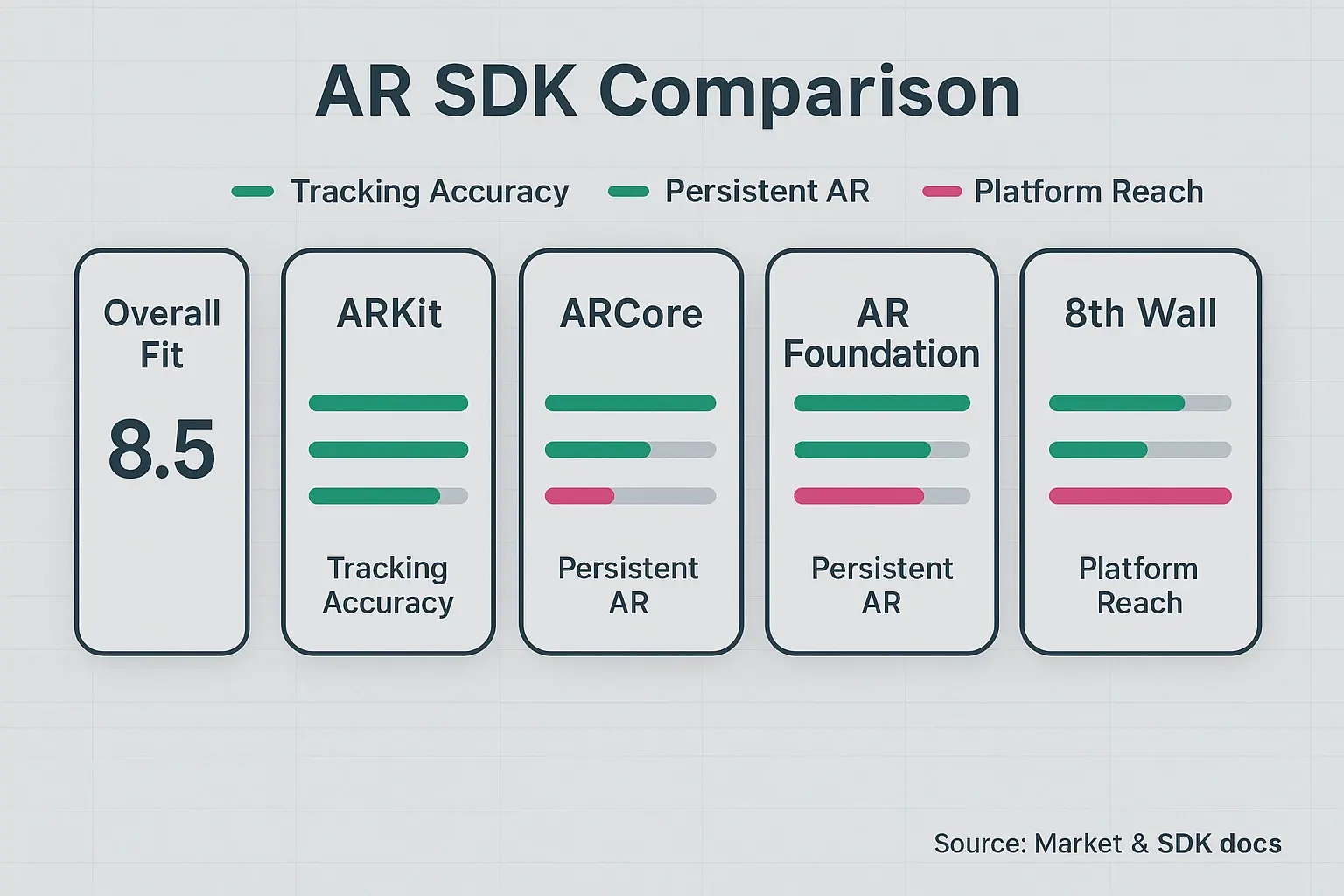
Selecting your SDK involves weighing factors like target audience (iOS vs. Android), development resources (native vs. engine-based), and the specific mechanics of your game (location-based vs. tabletop).
A Practical UX Checklist for AR Game Readiness
Before committing to a full development cycle, your concept must pass a rigorous user experience check. A technically impressive demo can still fail if the user experience is confusing or uncomfortable. Use this checklist during your evaluation phase to identify potential red flags.
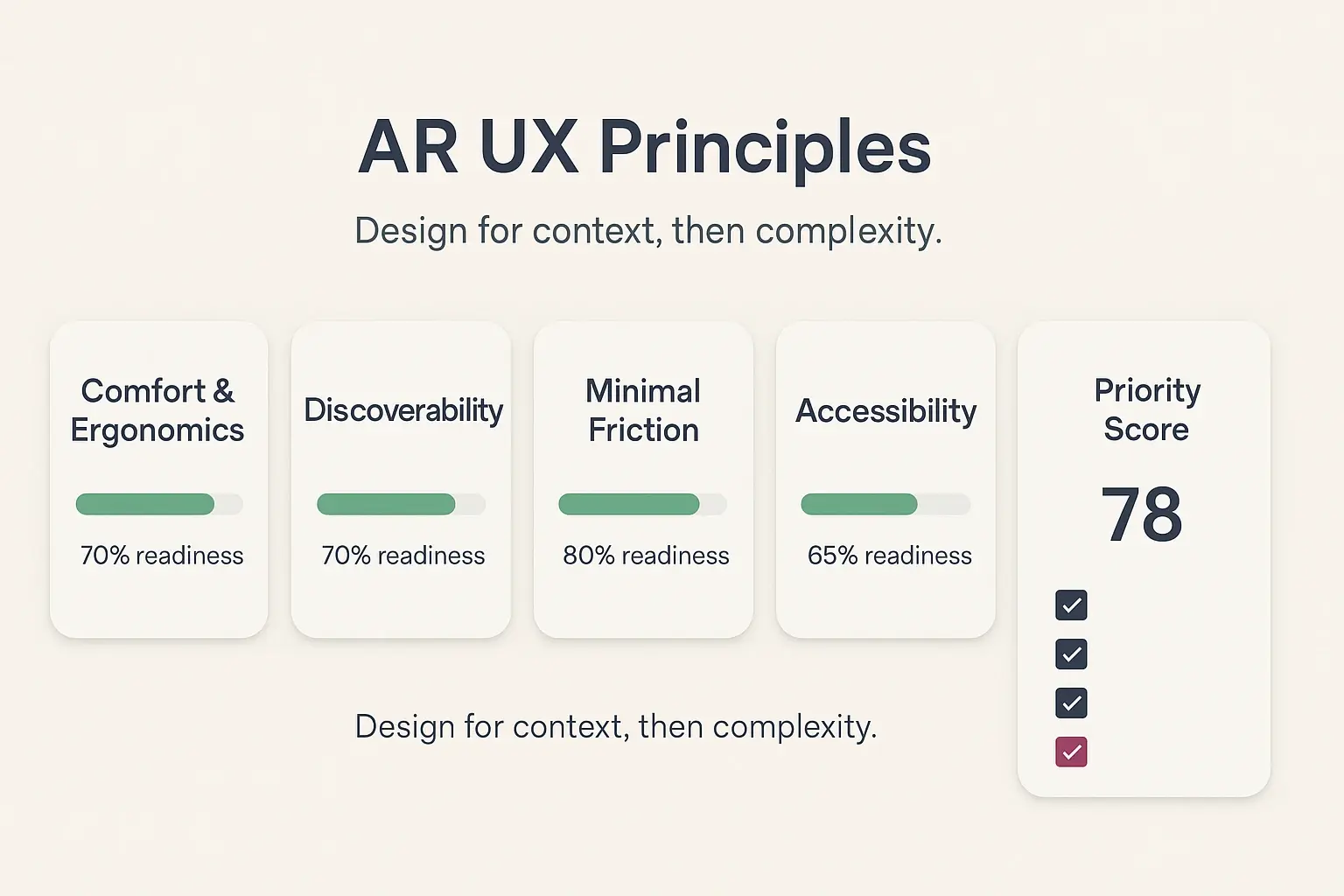
If you can confidently check these boxes, your concept has a strong UX foundation. If not, it’s a sign to revisit the core design before investing further.
While the creative possibilities of AR are vast, the technical hurdles are significant. Success depends on anticipating and solving key performance and usability challenges that are unique to AR.
- Challenge: Precision Tracking & Spatial Mapping
- The Problem: Jitter, drift, and inaccurate surface detection can quickly break immersion, making virtual objects appear to float or skate unnaturally.
- The Solution: Leverage the latest SDK features for environmental understanding. Use multiple plane detection and encourage players to scan their environment thoroughly during an initial setup phase. For multiplayer, robust spatial anchor solutions are non-negotiable.
- Challenge: Performance Optimization for Mobile
- The Problem: AR is incredibly demanding, simultaneously running the device camera, complex tracking algorithms, and 3D rendering. This leads to rapid battery drain and overheating.
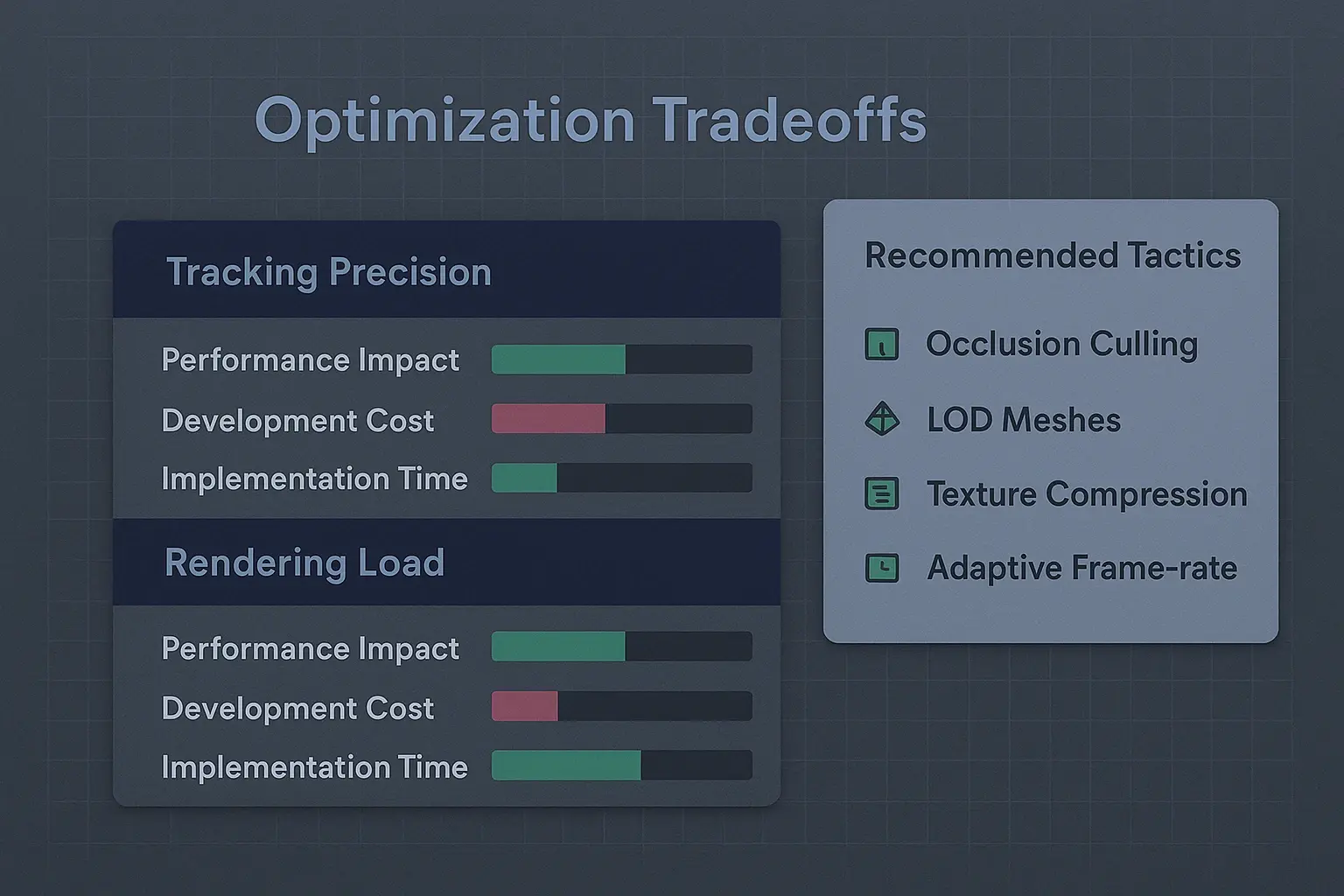
- The Solution: A ruthless approach to optimization is essential. This includes using simplified 3D models (low polygon counts), texture compression, and aggressive Level of Detail (LOD) systems. Effective AR/VR game testing across a wide range of devices is critical to finding performance bottlenecks before launch.
- Challenge: Realistic Lighting and Rendering
- The Problem: Virtual objects that don’t match the real-world lighting look fake and out of place.
- The Solution: Implement real-time lighting estimation. Modern SDKs can analyze the camera feed to estimate the color, intensity, and direction of ambient light, allowing you to generate realistic shadows and reflections that ground your virtual objects in reality.
Making smart technical tradeoffs is key. Not every game needs photorealistic rendering, and sometimes a simpler, more stylized approach can deliver a better and more stable experience for users.
Monetizing AR Games: Strategies for Sustainable Growth
The novelty of AR can attract users, but a smart monetization strategy is what builds a sustainable business. With mobile devices holding over 50% of the AR gaming market share, established mobile monetization models are a good starting point, but they must be adapted for the unique context of AR.
- In-App Purchases (IAP): The dominant model. Focus on virtual goods that enhance the AR experience—custom decorations for a user’s real room, unique skins for AR characters, or special effects that interact with the physical world.
- Location-Based Partnerships: For games like Pokémon GO, partnering with real-world businesses (e.g., coffee shops, retail stores) to turn them into in-game locations is a powerful revenue driver.
- Advertising: Branded AR content can be highly effective. Imagine a furniture brand letting you place a true-to-scale virtual sofa in your living room or a fast-food chain sponsoring a location-based quest.
- Subscription Models: Best suited for games offering continuous content updates, persistent world features, or access to a library of AR experiences.
Choosing the right model depends on your game’s genre and target audience. For instance, the strategies for hyper casual game development in AR would lean heavily on ads and simple IAPs, while a deeper RPG might support a subscription.
The Road Ahead: Future-Proofing Your AR Game
The AR landscape is evolving at a breakneck pace. To stay competitive, you need to build with the future in mind. Several key trends are shaping the next generation of AR gaming.
- AI-Powered Experiences: Artificial intelligence is making AR worlds more dynamic and responsive. Imagine NPCs that can intelligently navigate real-world obstacles or games that adapt their difficulty based on a player’s real-time environment.
- The Rise of Wearables: While mobile remains dominant, wearable AR hardware like smart glasses is growing at a projected 28% CAGR. Designing experiences that can transition from a phone to hands-free glasses will be a key differentiator.
- 5G and Cloud Streaming: 5G’s ultra-low latency will unlock sophisticated, persistent multiplayer AR experiences that would be impossible on current networks, streaming complex assets from the cloud to keep mobile devices from being overloaded.
- The Spatial Web: The convergence of these technologies is leading toward a persistent digital layer over the physical world, a foundational element of the metaverse gaming platform concept where user-generated content and social interaction are paramount.
Frequently Asked Questions
Absolutely. While still emerging, the market’s projected growth to over $90 billion by 2032 indicates massive potential. North America currently leads with a 38.5% market share, but Asia-Pacific is the fastest-growing region. Success hinges on creating a high-quality, non-gimmicky experience that offers real value and replayability, not just novelty.
The most common pitfall is treating AR as a feature rather than the core of the experience. Simply adding an “AR mode” to a traditional game rarely works. The best AR games are designed from the ground up to leverage the unique capabilities of the medium—spatial awareness, real-world interaction, and social co-presence.
The choice depends on your goals. For the highest fidelity, deepest feature set, and best performance, a native app built with ARKit/ARCore is the clear winner. For maximum reach, instant accessibility, and short-form experiences like marketing campaigns or mini-games, WebAR (using platforms like 8th Wall) is superior because it eliminates the friction of an app store download.
AR testing is more complex than traditional game QA. You must test across a wide matrix of devices, operating system versions, and—most importantly—diverse physical environments (different lighting, room sizes, surfaces). Because of this complexity, allocating a more significant portion of your budget and timeline to QA is crucial for a successful launch. A partner with a robust device lab and experience in spatial computing is invaluable here.
Your Partner in Building the Future of Play
Developing a successful AR game is a journey that requires a fusion of creative vision, deep technical expertise, and a user-centric design philosophy. From crafting the initial concept and building immersive 3D assets to rigorous quality assurance and data-driven analytics, every stage presents unique challenges.
By focusing on a design that blends seamlessly with the user’s world, choosing the right technical foundation, and planning for the future of spatial computing, you can move beyond the novelty and create truly memorable interactive experiences.
If you’re ready to turn your vision for an AR game into reality, our team of over 700 career gamers and technical experts is here to help you navigate every step of the development lifecycle. Let’s build the next generation of immersive game developer experiences together.
