

Designing for the Metaverse: A Guide to Future-Proof Architecture & Interoperability
- January 20, 2026
- Posted by: Saravana N S
- Category: Top Picks by iXie

You’re past the initial hype. You understand the metaverse isn’t just a single game or platform; it’s the next evolution of digital interaction, a persistent, interconnected space with a market projected to reach over $7 trillion by 2035. Now you face the real challenge: how do you build for it?
Traditional game development principles provide a foundation, but they don’t fully address the unique architectural demands of persistence, massive scale, and true interoperability. Simply listing the “best game engines” isn’t enough. You need a strategic framework that connects the tools you use to the complex systems you must build.
This guide provides that framework. We’ll move beyond surface-level comparisons to explore the core architectural layers, interoperability models, and strategic decisions required to build resilient, scalable, and connected metaverse experiences.
Contents
Why Metaverse Architecture is More Than Just a Game Loop
In traditional game development, the world often resets when the session ends. The metaverse is fundamentally different. It demands an “always-on” architecture designed for persistence, where actions have lasting consequences and the environment evolves even when individual users are offline.
This shift introduces a new set of technical challenges that a standard game loop wasn’t designed to handle. We’re now building for:
- Massive Concurrency: Supporting thousands or even millions of simultaneous users in a single, shared, and coherent instance.
- Distributed State Management: Ensuring every user sees a consistent version of the world, no matter where they are, requiring sophisticated data synchronization and sharding strategies.
- Economic Persistence: Creating systems for virtual economies where assets, currency, and identity have real, transferable value and must be managed securely.
This complexity has fueled a dynamic ecosystem of over 2,400 startups innovating across metaverse infrastructure, from rendering engines to interoperability protocols. Your architectural choices will determine whether your experience can integrate with this evolving landscape or if it remains a beautiful but isolated digital island.
Choosing Your Engine: A Metaverse-Ready Comparison
The game engine is the heart of your experience, but evaluating it for the metaverse requires a different lens. You’re not just looking for rendering power; you need to assess its ability to handle persistent worlds, extensive XR support, and a flexible architecture that can integrate with emerging standards.
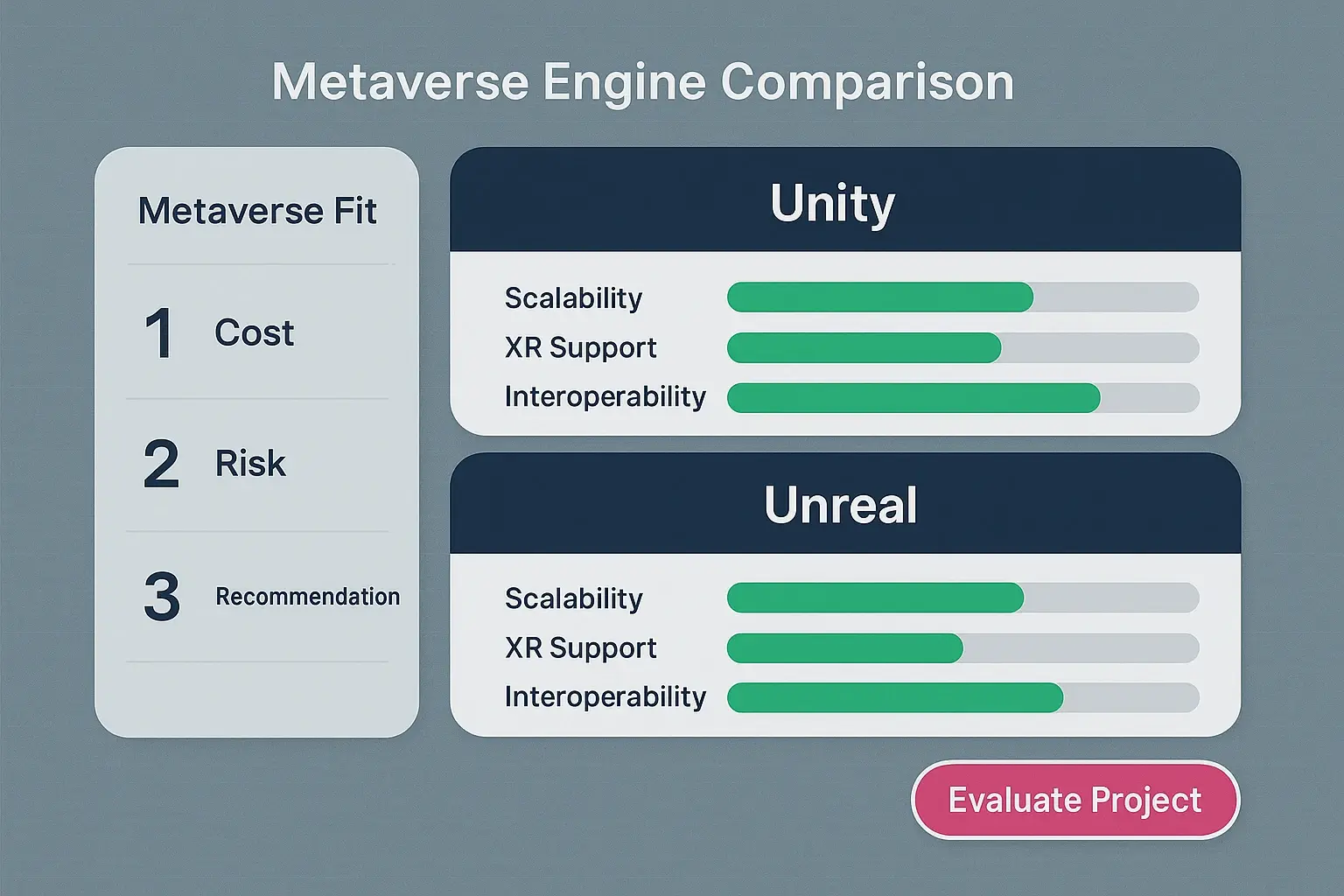
While Unity and Unreal Engine remain the dominant forces, their strengths align with different metaverse ambitions:
- Unreal Engine: Often chosen for high-fidelity, visually stunning experiences. Its strengths in real-time rendering and cinematic quality make it ideal for projects where aesthetic immersion is paramount. However, this visual power can come with higher hardware demands.
- Unity: Known for its flexibility and extensive platform support, making it a powerful choice for projects targeting a wide range of devices, from high-end VR headsets to mobile. Its robust asset store and large developer community accelerate development, especially for teams focused on ensuring cross-platform compatibility.
- Open Source Engines (e.g., Godot): Offer unparalleled customization and no licensing fees, making them attractive for projects with unique technical requirements or those prioritizing a fully open-source stack. The trade-off is often a smaller ecosystem of pre-built assets and a greater need for in-house technical expertise.
Your choice depends on your project’s core priorities: Is it visual fidelity, broad accessibility, or complete architectural control?
The Core Architectural Layers: Building a Resilient Foundation
A robust metaverse experience is built on several interconnected layers. Understanding how they work together is critical for planning a scalable and stable system.
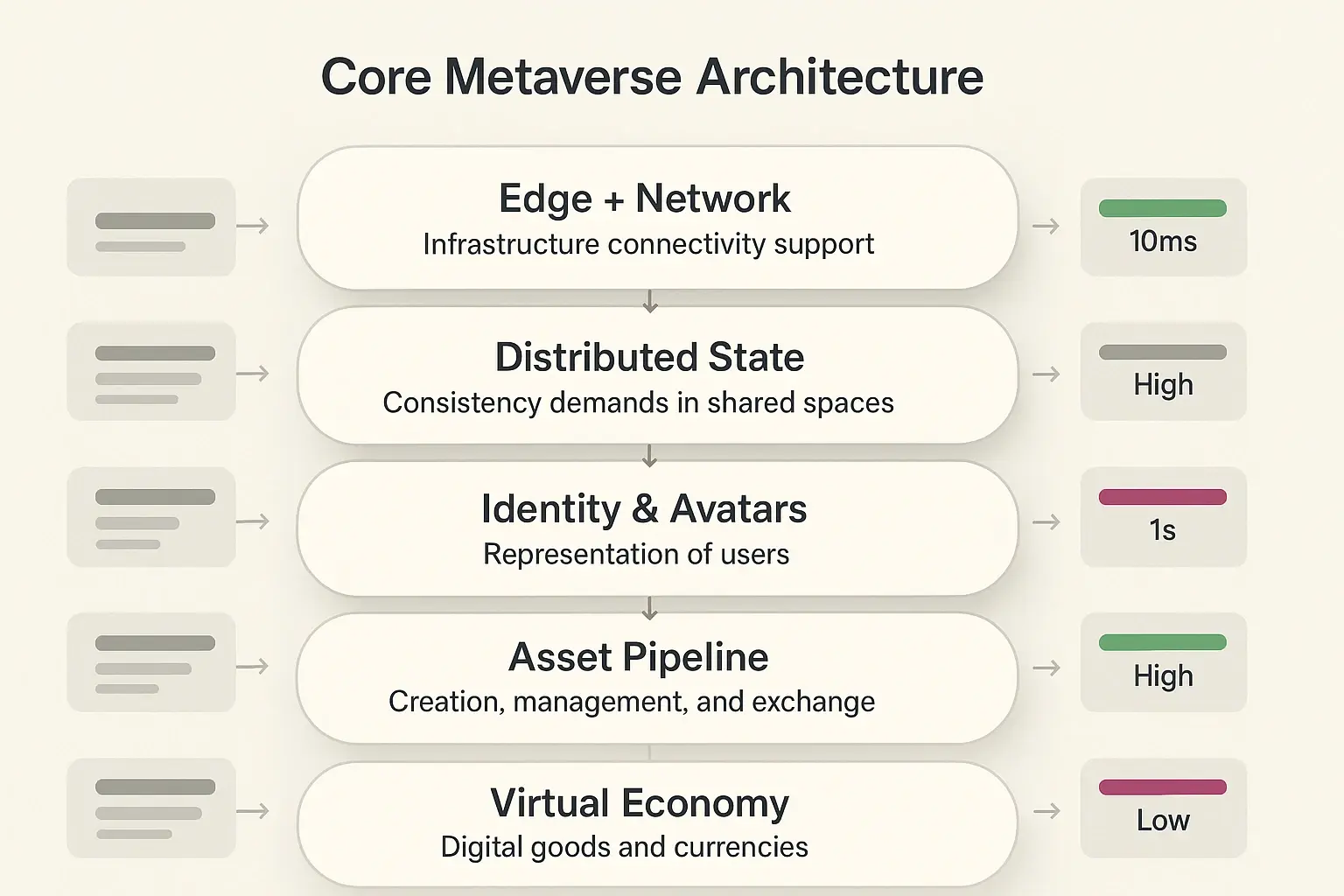
- Experience & Content Layer: This is what the user sees—the 3D assets, UI, and interactions. The quality of your art and design is crucial for engagement. Establishing a strong game style guide ensures a cohesive user experience.
- State Management Layer: This is the “brain” of your world. It manages the position and status of every object and user, synchronizing data across all clients to maintain a single source of truth.
- Networking Layer: For immersive XR, ultra-low-latency networking isn’t a luxury; it’s a requirement. This layer often relies on edge computing to process data closer to the user, reducing lag and ensuring smooth interactions.
- Identity & Asset Layer: This layer manages who users are and what they own. In the metaverse, this extends beyond a simple username to encompass portable identities, digital wallets, and verifiable ownership of assets.
A failure in any of these foundational layers can compromise the entire experience. Your architecture must be designed to balance performance, security, and scalability across all of them.
The Interoperability Imperative: Connecting Worlds and Economies
For the metaverse to reach its full potential, it must be interconnected. Users will expect to move seamlessly between worlds, bringing their identity, friends, and assets with them. This is the challenge of interoperability, and it’s as much a policy and design problem as it is a technical one.
Digital Identity: Beyond a Single Avatar
Early conversations about metaverse identity focused on portable avatars. The reality is far more complex. Digital identity is bifurcating into two main stacks: a “sovereign” stack for consumers (wallets, NFTs, decentralized IDs) and a “regulated” stack for enterprise use (KYC, role-based access).
True interoperability requires building bridges between these systems, allowing for federated identity models where users can selectively disclose aspects of their identity depending on the context—one profile for work, another for gaming, and another for social interactions.
Digital Assets: The “Logical Item, Multiple Renders” Model
How can a digital sword purchased in one stylized, low-poly world exist in a second, hyper-realistic one? The solution lies in separating the asset’s “logical” identity from its visual representation. An asset is essentially a token verifying ownership, which then points to different 3D models and textures depending on the platform it’s rendered in.
This approach is central to creating a viable NFT game development company strategy. It ensures assets have persistent value and utility across the ecosystem, a critical factor in building sustainable game economy design.
Choosing Your Interoperability Strategy
There is no one-size-fits-all approach to interoperability. Your strategy will depend on your project’s goals, risk tolerance, and technical resources.
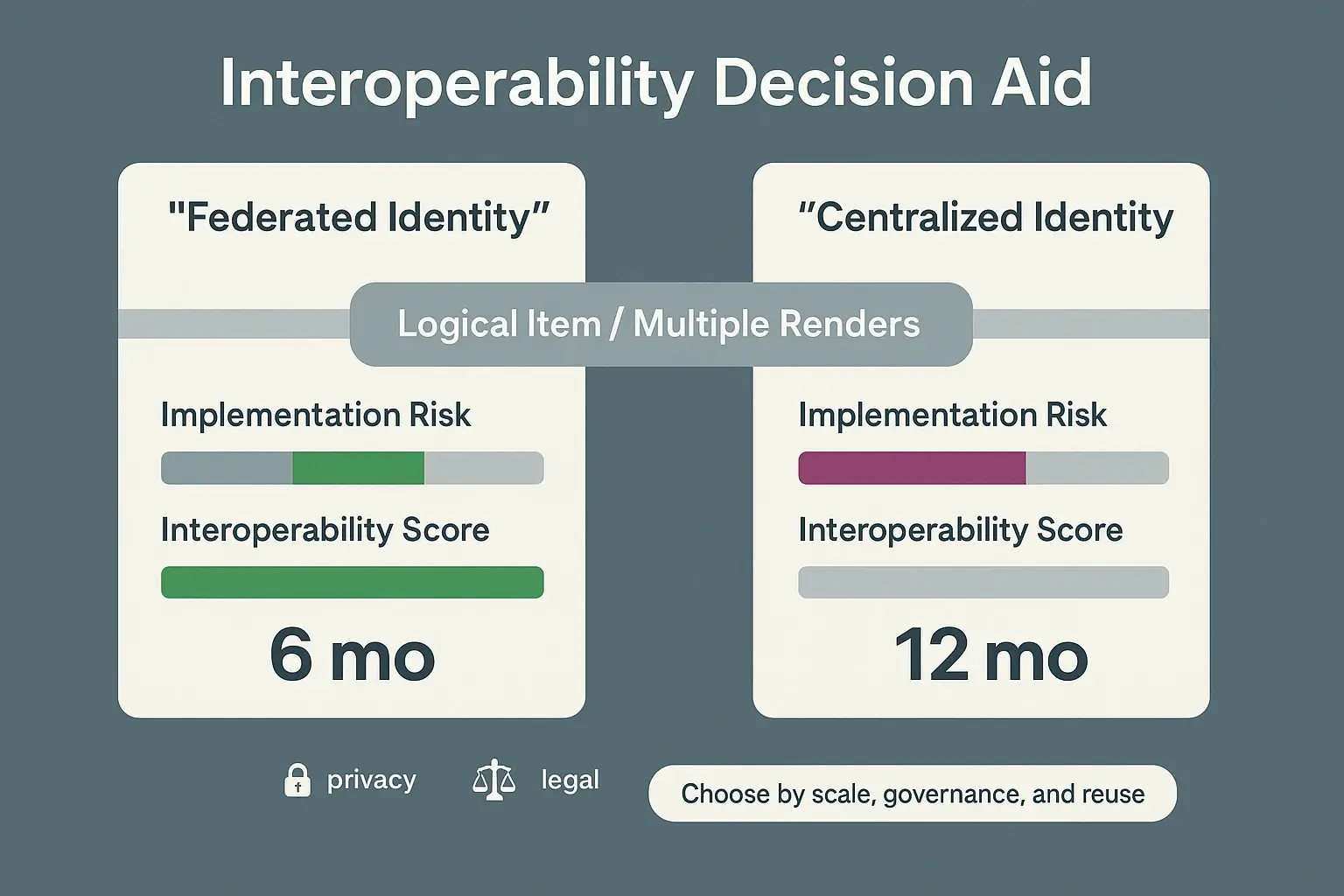
- Proprietary / Walled Garden: Full control over the user experience and economy. Easiest to implement and secure but sacrifices cross-world connectivity.
- Federated Partnership: Bilateral agreements with specific platforms to allow limited asset and identity transfer. A balanced approach that offers controlled interoperability without opening up to the entire ecosystem.
- Open & Decentralized: Leverages public blockchains and open standards (like glTF and OpenXR) for maximum interoperability. This approach offers the greatest future potential but also introduces significant technical complexity and security considerations, highlighting the scope and challenges of NFT game development.
A Strategic Framework for Your Metaverse Project
As you move from evaluation to execution, your decisions should be guided by a clear strategy. A well-defined cross-platform release strategy is essential from day one. Ask your team these critical questions:
1. What level of persistence does our world require? Will it be a static environment or a dynamic world that evolves based on user actions? This will dictate your state management and backend architecture.
2. Who is our target user and what devices will they use? This will influence your choice of engine and your approach to performance optimization and cross-platform compatibility.
3. What is our strategy for digital identity and assets? Will we build a closed ecosystem or embrace open standards for interoperability?
4. How will we leverage AI? Generative AI can dramatically accelerate content creation. The debate between a traditional vs. AI-enhanced art workflow is a key strategic decision impacting both budget and production timelines.
Answering these questions early will provide clarity and help you build a cohesive development roadmap that aligns your technical architecture with your business goals.
Frequently Asked Questions (FAQ)
Q1: How do I choose between a centralized and decentralized architecture?A centralized architecture offers more control, higher performance, and simpler development, making it ideal for experiences where you manage the entire ecosystem. A decentralized architecture, often built on blockchain, provides user ownership of assets, transparency, and censorship resistance. The choice depends on your core value proposition: control and performance vs. user empowerment and openness.
Q2: Isn’t “interoperability” just a buzzword? What’s a practical first step?It’s more than a buzzword—it’s a long-term goal. A practical first step is to adopt open standards for your assets, such as using the glTF format for 3D models. This doesn’t achieve full interoperability on its own, but it makes your assets “interoperability-ready” for future integrations without requiring a complete rework.
Q3: How much does building a metaverse experience cost?Costs vary dramatically based on complexity. Simple social media integrations might start around $15,000, while complex, high-fidelity simulations for sectors like healthcare can exceed $1,000,000. The key cost drivers are asset creation, backend engineering for persistence and scale, and ongoing content updates and moderation.
Q4: What are the biggest security risks I should plan for?XR devices capture vast amounts of biometric and behavioral data, creating new privacy risks. Additionally, virtual economies are prime targets for fraud and theft. Your architecture must incorporate privacy-by-design principles and robust security for managing user identity and digital assets, especially if they have real-world value.
Architecting the Future, Together
Building for the metaverse is a monumental undertaking that combines the art of game design with the discipline of enterprise-level systems architecture. The decisions you make today about your engine, core architecture, and interoperability strategy will define your project’s potential for years to come.
Success requires a partner with deep expertise across the entire development lifecycle—from the initial art production, where the future of art and AI in game production is being defined, to the rigorous QA needed for persistent, multi-platform worlds. As you architect the future, a team that understands every layer of the stack can help you navigate the complexity and build experiences that are not only immersive but also resilient, scalable, and ready for the interconnected world to come.
