

Beyond the Buzzwords: An Agile Playbook for Modern Game Production
- January 20, 2026
- Posted by: Saravana N S
- Category: Top Picks by iXie
You’ve read the manifestos and seen the diagrams. You might even be running daily stand-ups and planning sprints. But if you’re a game producer or studio lead, you know the truth: standard agile methodologies often feel like they’re built for a different world. A world without the unpredictable, chaotic, and exhilarating quest for “fun.”
Game development isn’t about building predictable features; it’s about discovering an experience. This is why applying generic agile practices without deep adaptation can lead to frustration, creative friction, and the dreaded “cargo-cult Scrum”—all the meetings, none of the magic.
This guide is for you. It’s a middle-of-the-funnel playbook designed to move past the basics and into the nuanced, practical application of agile principles specifically for game production. We’ll explore how to harness agile’s power not just to manage tasks, but to foster creativity, mitigate risk, and build better games, faster and more sustainably.
Contents
- 1 Decoding Agile for Games: The “Why” Before the “How”
- 2 Agile Frameworks in the Trenches: Choosing Your Methodology
- 3 The Technical DNA of Agile Game Production
- 4 Beyond the Sprint: Strategic Project Management
- 5 The Next Frontier: AI, Live Ops, and Your Agile Workflow
- 6 Choosing Your Arsenal: The Right Tools for Your Studio
- 7 Crafting Unforgettable Games, Sustainably
Decoding Agile for Games: The “Why” Before the “How”
The Agile Manifesto prioritizes “individuals and interactions over processes and tools.” For creative teams, this isn’t a suggestion; it’s the only way to succeed. While general software projects report success rates as high as 75.4%, academic research highlights a more complex picture in gaming. Agile provides huge benefits for project management and programming but shows less impact on art, design, and developer quality of life if implemented poorly.
The reason is simple: game development is fundamentally an exploratory process. Unlike building a banking app, you don’t always know the final destination. You’re chasing an emotion, a feeling of play. This requires a framework that embraces, rather than resists, constant change and discovery.
Agile Frameworks in the Trenches: Choosing Your Methodology
There is no single “best” framework. The optimal choice depends on your team, your project’s genre, and its current stage of development. Most successful studios use a hybrid approach, adapting their methodology as the project evolves from pre-production to live ops.
Scrum: The Structure for Predictable Sprints
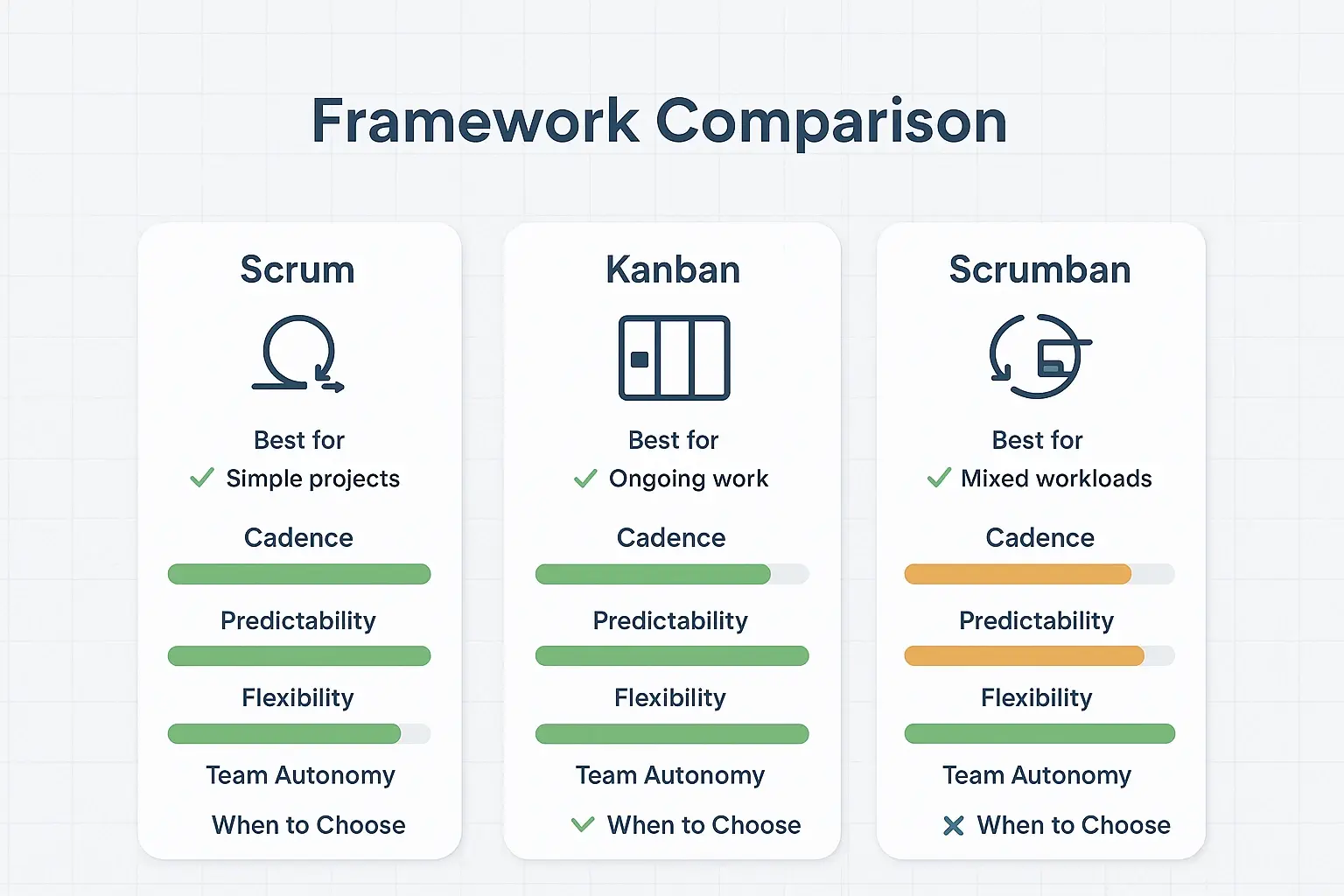
Scrum provides a structured rhythm with fixed-length sprints (usually 2-4 weeks), defined roles (Product Owner, Scrum Master, Development Team), and clear ceremonies.
- Best For: Production phases with a known backlog, core mechanic implementation, and feature development where work can be broken into predictable chunks. It excels at creating a steady, measurable velocity.
- Challenges in Games: Can feel restrictive for art and design teams whose creative process doesn’t fit neatly into two-week boxes. The exploratory nature of pre-production can make sprint planning difficult.
Kanban: The Flow for Continuous Delivery
Kanban is a visual system focused on continuous flow and limiting work-in-progress (WIP). Tasks move across a board from “To Do” to “Done” without fixed sprints.
- Best For: Art and audio pipelines, QA testing, and live ops where tasks are varied and arrive continuously. It’s excellent for visualizing bottlenecks and managing the unpredictable flow of creative asset requests.
- Challenges in Games: Less effective at long-term planning and forecasting without fixed iteration cycles. It requires strong team discipline to prevent scope creep.
Scrumban: The Hybrid Powerhouse
Scrumban combines Scrum’s structure with Kanban’s flexibility. Teams often use sprints for planning and retrospectives but manage daily workflow using a Kanban board to allow for more fluid task management.
- Best For: Studios that need the planning cadence of Scrum but the workflow flexibility of Kanban. It’s a great fit for teams managing both planned feature work and emergent tasks like bug fixes or creative polishing.
The Technical DNA of Agile Game Production
Generic agile advice breaks down when it hits the complex, multi-disciplinary reality of game development. True mastery lies in adapting the core principles to your specific technical and creative pipelines.
Managing Multi-Disciplinary Pipelines
Your art, audio, design, and engineering teams operate on different cadences. Forcing everyone into a single, rigid sprint is a recipe for inefficiency.
- The Solution: Run parallel systems that interface at key points. Your engineering team might run two-week sprints, while your art team uses a Kanban board for a continuous flow of assets. The key is to establish formal “interface contracts”—clear definitions of when and how assets are handed off, with agreed-upon technical specifications. This allows each team to optimize its own process while ensuring seamless integration.
Iteration Budgeting and Cost Control
In gaming, iteration is essential but can be incredibly costly. Uncontrolled iteration is a primary driver of scope creep and crunch.
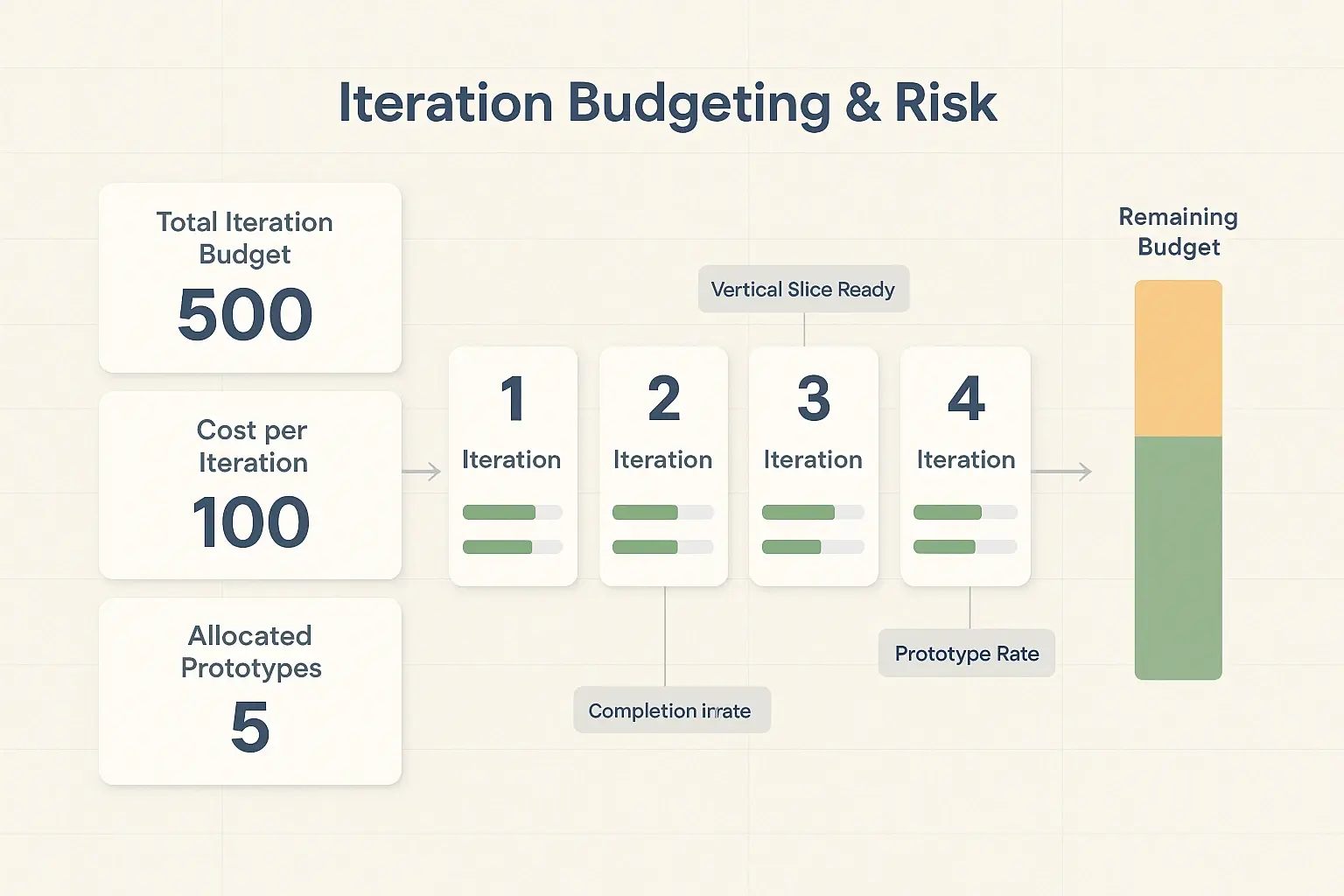
- The Solution: Quantify and track your iteration cost. Treat iteration as a feature with a budget. For each major system, allocate a specific number of “iteration cycles” in your plan. This forces deliberate decisions. Is this visual effect “good enough” for now, or is it worth spending another cycle from our iteration budget? This approach turns a vague desire for polish into a measurable project cost.
Prototyping as a Continuous Pipeline
Don’t treat prototyping as just a phase. Set up a “discovery track” within your production—a parallel workflow dedicated to creative spikes and testing new ideas. This track has different rules: speed is valued over stability, and the output isn’t shippable code but validated learning. This keeps innovation flowing without derailing your main production schedule.
Beyond the Sprint: Strategic Project Management
Effective agile isn’t just about managing tasks; it’s about building a sustainable system for creating great games.
Scaling Agile Without the Chaos
For large teams, a “Scrum of Scrums” is a common approach to coordinate multiple teams. However, success depends less on the ceremony and more on designing your game architecture to minimize dependencies. If Team A is constantly blocked waiting for Team B, your problem isn’t your agile process—it’s your code or content structure. A successful large-scale game co development effort requires this level of architectural foresight.
Managing Crunch as a Process Defect
Crunch is not a badge of honor; it’s a symptom of a broken process. Research consistently shows that tooling and pipeline weaknesses are root causes of schedule slips.
- Treat Crunch as a Bug: When a team works excessive overtime, your post-mortems shouldn’t just celebrate their dedication. They should perform a root cause analysis. Was it a planning failure? A technical bottleneck? A late dependency?
- Track Your “Health Metrics”: In your sprint reviews, report on team health alongside velocity and burndown. Track metrics like unplanned overtime and team sentiment. Making these visible treats them as first-class citizens of project health. This is vital for any project, including complex mobile game development services.
The Next Frontier: AI, Live Ops, and Your Agile Workflow
The industry is evolving, and your production process must evolve with it. Agile is uniquely suited to adapt to these transformative trends.
Integrating Generative AI
Experts predict that generative AI in gaming could accelerate content development by up to 90%. This isn’t just about creating assets faster; it’s about enabling high-frequency prototyping. Your agile workflow needs to adapt to a world where you can test dozens of level layouts or character designs in the time it used to take to create one. Sprints may become shorter, focused on integrating and testing AI-generated content rather than creating it from scratch. This also has profound implications for quality assurance, where a robust regression game testing strategy becomes even more critical to validate changes.
Agile for Games-as-a-Service
Modern games are “infinite products” that require continuous delivery. For these titles, the principles of agile are more relevant than ever.
- Shift to Data-Driven Backlogs: In a live game, player data is your most important stakeholder. Your backlog should be heavily influenced by analytics on player behavior, engagement, and monetization.
- Embrace Continuous Delivery: The goal for any team managing game liveops is to shorten the cycle time from idea to deployment. This requires robust automation in your build and testing pipeline to release new content and features safely and frequently.
Choosing Your Arsenal: The Right Tools for Your Studio
The right project management tool can supercharge your agile process, but the tool should always serve the methodology, not dictate it. Your choice depends heavily on your studio size, budget, and chosen framework.
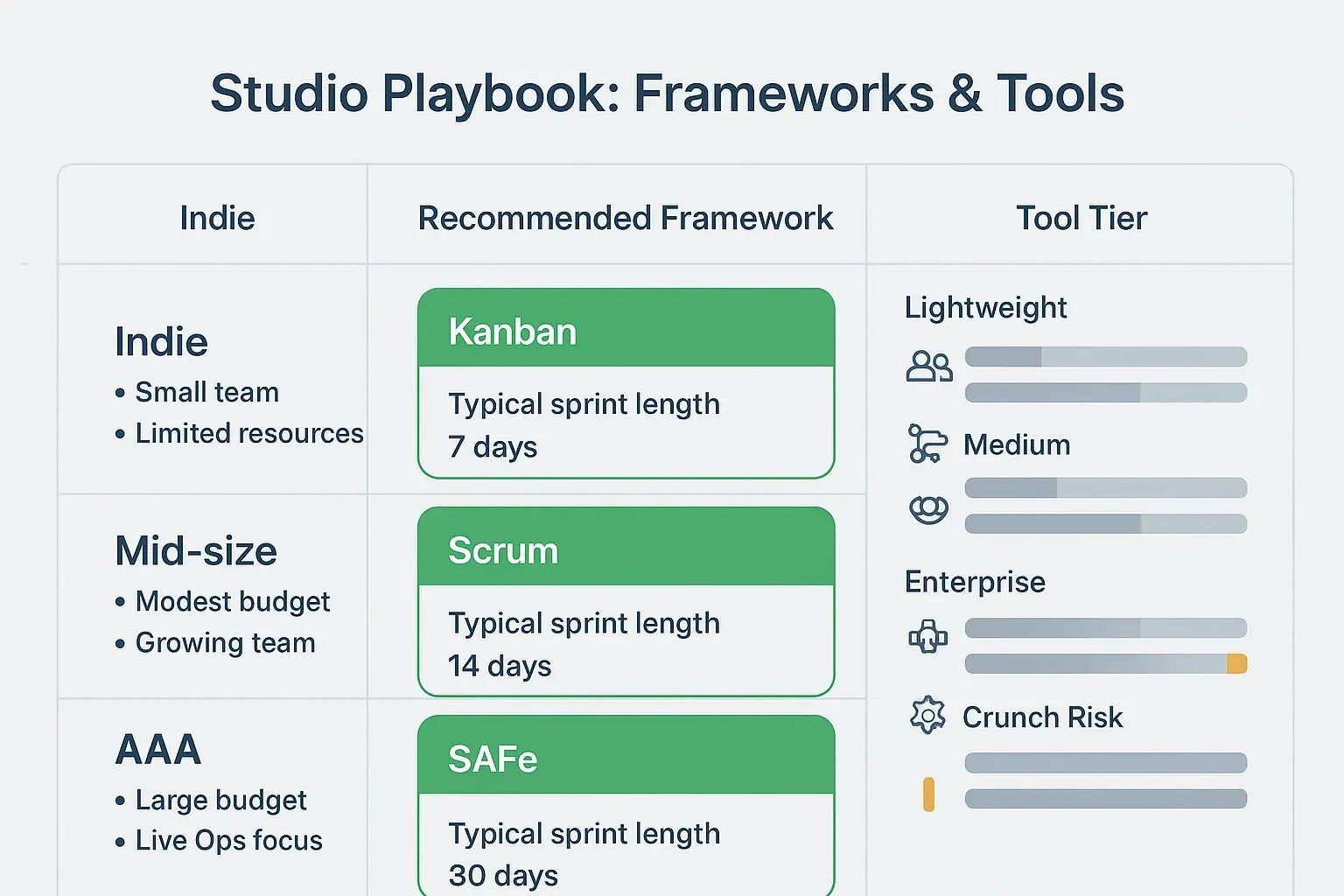
- For Small Indie Teams: Tools like Trello or Codecks offer simplicity and visual clarity, perfect for Kanban-style workflows and managing the varied hats indie developers wear.
- For Mid-Sized Studios: Jira and Asana provide more robust features for Scrum, backlog management, and reporting. They offer a good balance of structure and customization.
- For Large AAA Studios: Highly customized Jira instances, Perforce’s Hansoft, or proprietary internal tools are common. At this scale, the focus is on managing complex dependencies, multi-studio collaboration, and integrating with other enterprise systems.
Crafting Unforgettable Games, Sustainably
True agility in game development isn’t about adhering to a rigid set of rules. It’s a mindset built on continuous learning, transparent communication, and a deep respect for both the craft and the people who practice it.
By adapting these principles to the unique creative chaos of game production, you can build a process that not only delivers amazing games on time and on budget but also fosters a healthy, sustainable, and innovative studio culture.
Frequently Asked Questions
1. How do you implement agile when publishers demand fixed deadlines and feature lists (Waterfall)?
This is a common reality. The key is to use agile within the fixed scope. You can break the project into major milestones that satisfy the publisher’s requirements, but use sprints and iterative development to build the features for each milestone. This allows you to adapt to design challenges and technical discoveries along the way, delivering a higher-quality result within the fixed constraints. It also provides frequent opportunities to show progress and de-risk the project for the publisher.
2. Isn’t this level of process and planning stifling for creative teams like artists and designers?
It can be, if implemented incorrectly. The goal is not to turn artists into factory workers. Instead, a well-run agile system protects creative work. By using a Kanban-style flow, artists can pull work as they have capacity, rather than having it pushed on them. By limiting work-in-progress, you give them the focus to do their best work. The process should serve creativity by providing clarity and removing obstacles, not by dictating the creative act itself.
3. Our team is small. Do we really need all these formal roles and ceremonies?
No. Agile principles are scalable. A solo developer or a three-person indie team can benefit immensely from a simple Kanban board to visualize work, a weekly meeting to plan priorities, and a “retrospective” (even if it’s just a 15-minute chat) to ask “What could we do better next week?” The goal is the outcome—transparency, focus, and continuous improvement—not the rigid adoption of every Scrum rule.
4. How do we get started transitioning from our current process?
Start small and iterate. Don’t try to change everything overnight.
- Step 1: Visualize Your Work. Create a simple “To Do,” “In Progress,” “Done” board for a single team or pipeline.
- Step 2: Introduce a Daily Stand-up. A quick, 15-minute meeting to sync on progress and blockers.
- Step 3: Hold a Retrospective. At the end of a week or two, ask the team what went well, what didn’t, and what one thing you can change to improve.This iterative approach to process improvement is, in itself, the heart of being agile.
