January 20, 2026
Discover practical agile strategies tailored for game production to...

You’re staring at a paradox. The industry is buzzing with innovation, yet over 10,000 developer jobs were cut last year. Your teams are being asked to do more with less—60% are now focused on extending existing games rather than launching new ones. You know that upskilling is the answer, but the path forward feels cluttered with generic advice and individual training courses that don’t address your studio’s real challenge: building a resilient, future-proof team.
The old model of hiring for specific skills and hoping for the best is broken. Today, winning studios are building strategic talent ecosystems. They’re proactively identifying skill gaps, integrating new technologies like Generative AI, and creating career paths that turn jobs into long-term vocations.
This isn’t just about employee satisfaction. It’s about survival and competitive advantage. Organizations with comprehensive training achieve 218% higher income per employee and 24% higher profit margins. This guide moves beyond the theory to give you an actionable framework for designing, implementing, and measuring a continuous learning culture that delivers real business results.
The demand for game development talent is growing at an unprecedented rate, with job growth projected at 22% between 2020 and 2030. Yet, a critical shortage of trained professionals in key areas creates a significant bottleneck for studios aiming to innovate and scale.
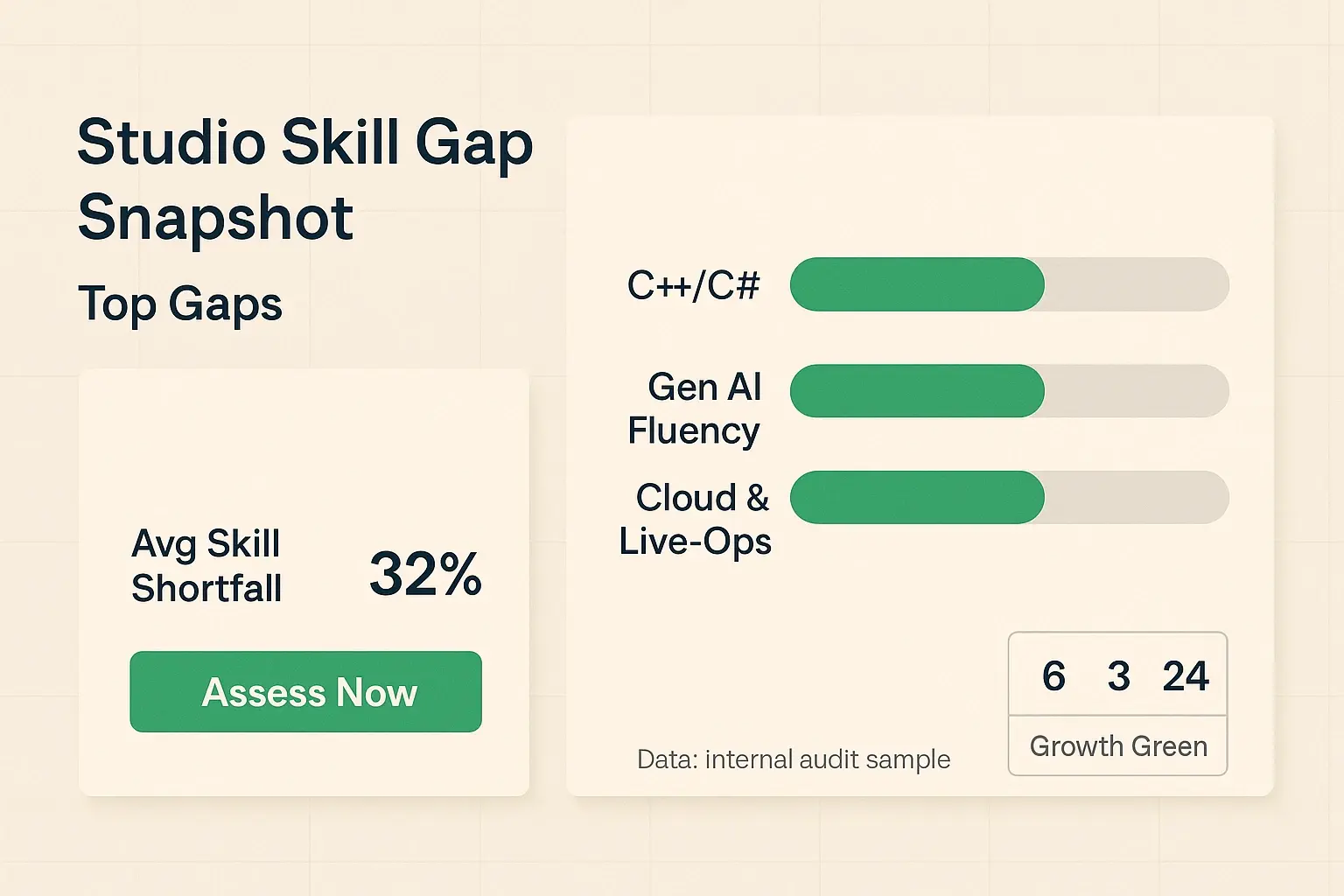
The most acute gaps aren’t just in niche specializations; they’re in the foundational technologies that power modern gaming:
For studio leaders, the first step isn’t just acknowledging these trends but diagnosing their specific impact on your team. A systematic skill audit can reveal where your team is strong and, more importantly, where it’s vulnerable. Moving beyond anecdotal evidence to a data-driven overview is the first step toward targeted, effective training.
The conversation around AI in game development is often dominated by fear of replacement. The data, however, points to a different reality: augmentation. AI isn’t eliminating developers; it’s transforming their roles and creating an urgent need for new skills.
Already, nearly 20% of new games on Steam disclose the use of AI, a share that doubled in just one year. This rapid adoption signals a fundamental shift in the development process. AI is automating repetitive tasks, accelerating content creation, and enabling unprecedented levels of dynamic gameplay. This frees up your most valuable talent to focus on what humans do best: vision, complex creative decisions, and emotional nuance.
To capitalize on this shift, your training focus must evolve. The essential skills for the AI era include:
Studios that proactively train for these competencies will gain a significant efficiency advantage. Understanding the trends in the generative ai in gaming market is the first step to building a team that can harness its power.
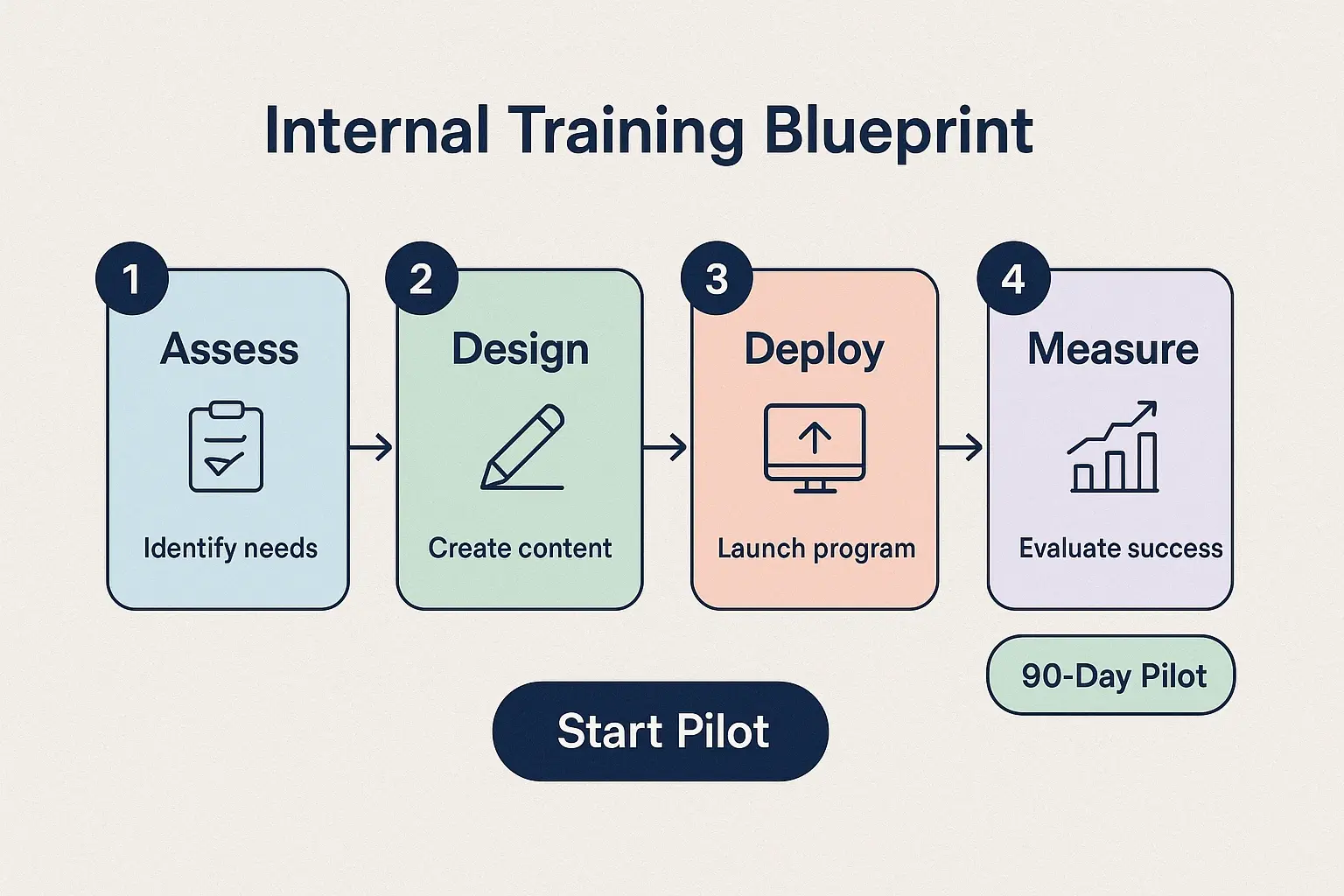
One-off workshops and access to online course libraries are a start, but they don’t create a culture of learning. A truly effective program is a structured, ongoing initiative designed around your studio’s specific goals.
Before you can build, you must measure. Use a combination of tools to get a clear picture of your team’s current capabilities:
With a clear diagnosis, you can design a bespoke curriculum. Focus on practical application over passive learning.
You don’t need a perfect, studio-wide program from day one. Start with a focused 90-day pilot targeting one key skill gap in a single team. This allows you to test your approach, gather feedback, and demonstrate value quickly before scaling.
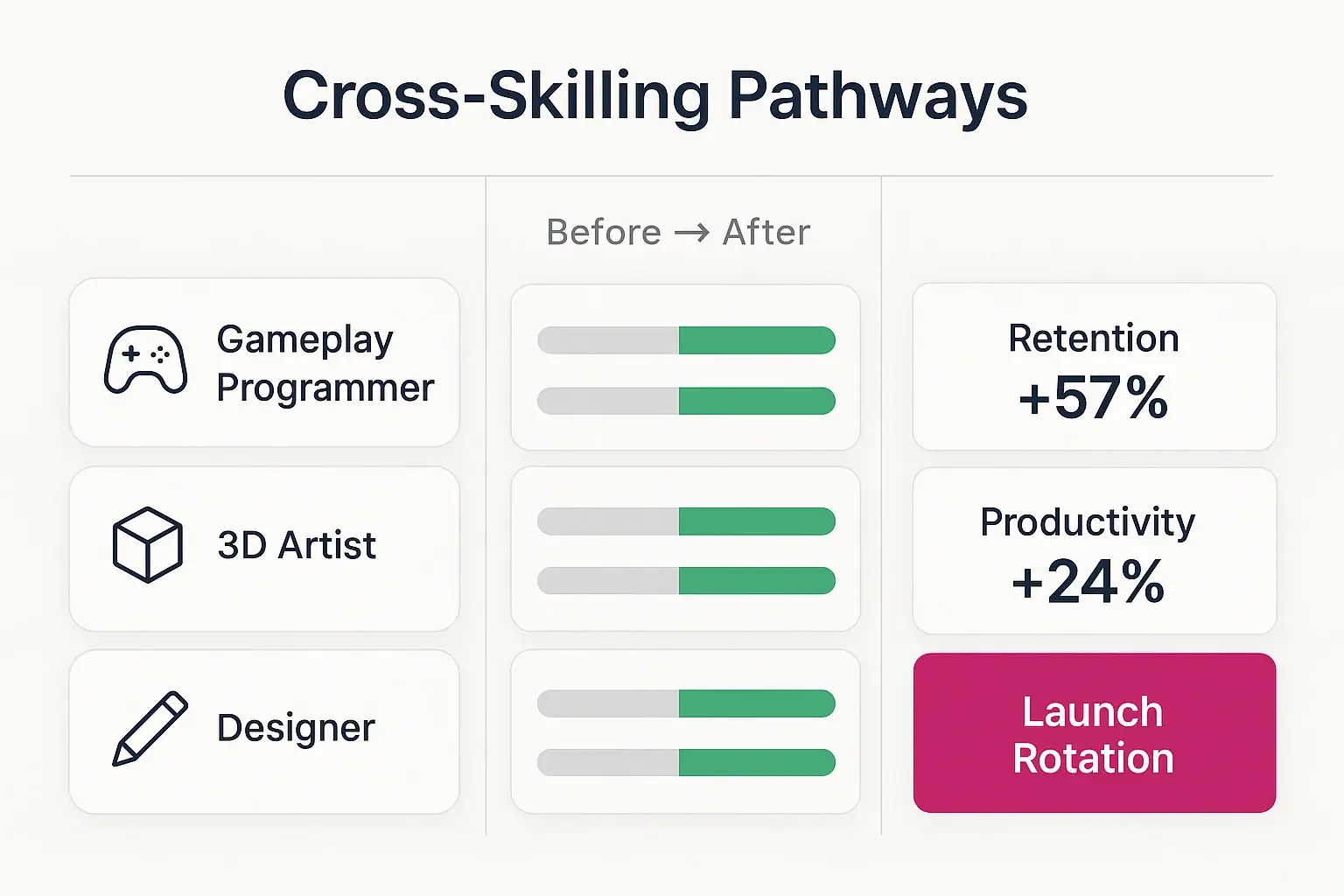
In today’s lean environment, hyper-specialization can be a liability. When a key specialist becomes a bottleneck, the entire project stalls. Cross-skilling—the practice of intentionally training employees in skills outside their core discipline—is the antidote.
A gameplay programmer who understands the basics of VFX can collaborate more effectively with the art team. A level designer who can write simple scripts can prototype ideas faster without waiting for engineering resources.
The benefits are twofold:
For the Studio: Increased flexibility, reduced production bottlenecks, and a more innovative, collaborative culture. Teams can adapt to changing project needs without having to hire new specialists for every task.
For the Developer: A broader skill set makes them more valuable and resilient. It opens up new career paths (e.g., from Artist to Technical Artist) and keeps them engaged by providing new challenges.
Implementing a cross-skilling program requires a deliberate look at how different gaming skills complement each other and align with your studio’s production pipeline.
One of the most powerful drivers of employee retention is the belief that they have a future at your company. A robust training program is meaningless if it doesn’t connect to a clear path for advancement.
Building transparent career progression frameworks moves promotions from a subjective mystery to an objective milestone. For each role family (e.g., Engineering, Art, Design), define clear levels (Junior, Mid, Senior, Lead) with specific competencies and performance indicators for each.
When developers can see exactly what skills and behaviors they need to demonstrate to reach the next level, they become active participants in their own growth. Link your training modules directly to these competencies. This transforms learning from a “nice-to-have” into an essential tool for career advancement. Clear career paths also depend on strong mentorship; seeing the real-world growth of our team leaders provides a powerful and tangible example for aspiring developers.
Ultimately, any learning and development initiative must answer to the bottom line. The good news is that the ROI of strategic training is significant and measurable. Strong learning cultures correlate with 57% higher employee retention and can save over $8,000 per employee annually through productivity gains alone.
Move beyond vanity metrics like “courses completed.” Track the metrics that directly impact your studio’s performance:
When you combine a robust training program with a forward-looking technology strategy, such as adopting new tools for gaming ar vr development, the ROI becomes even more compelling.
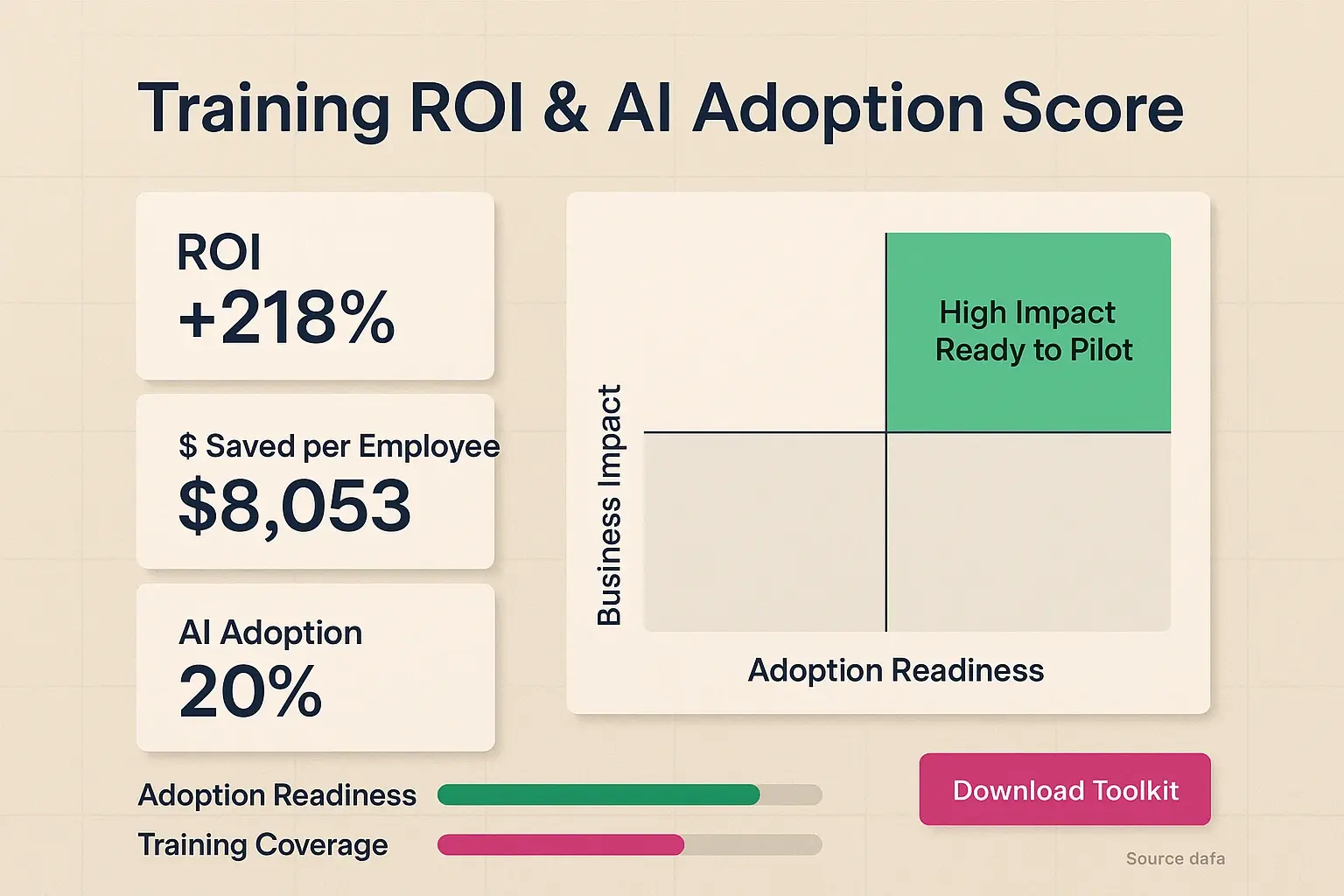
Start small. A 90-day pilot with a single team focused on one critical skill proves the concept and builds the business case for a larger investment. The ROI from increased productivity and retention often pays for the program itself.
Integrate learning into the workflow. Dedicate a few hours each week for “learning time,” encourage microlearning (short, 5-10 minute modules), and use lunch-and-learn sessions to share knowledge. The short-term time investment pays off in long-term efficiency.
Begin with awareness and experimentation. Host a workshop to demonstrate how new AI tools can assist in art, design, and coding. Create a small, cross-functional “AI task force” to pilot these tools on a non-critical project and report their findings back to the wider team.
Hiring for every new skill is expensive and slow. While external hires bring fresh perspectives, upskilling your existing team is more cost-effective, boosts morale, and increases retention. A healthy strategy involves a balance of both, but leading with internal development builds a more loyal and resilient workforce.
Investing in your team’s skills is no longer a perk; it’s a core business strategy. By moving from ad-hoc training to a structured, measurable, and career-focused development program, you’re not just filling skill gaps. You’re building a more innovative, efficient, and resilient studio capable of thriving in the ever-changing landscape of game development.
Ready to design a talent development strategy that drives real growth? Let’s talk about building a blueprint tailored to your studio’s unique challenges and goals.
Discover practical agile strategies tailored for game production to...

Explore key architecture and interoperability strategies to build scalable,...
Avalanche Software and Warner Bros. Entertainment are slated to...
